Xiaomi HyperOS 4 Beta Device List and Rollout Dates
Xiaomi’s HyperOS 4 beta starts August 14 across 26 devices in three waves. Full device list, dates, and the soft-light…

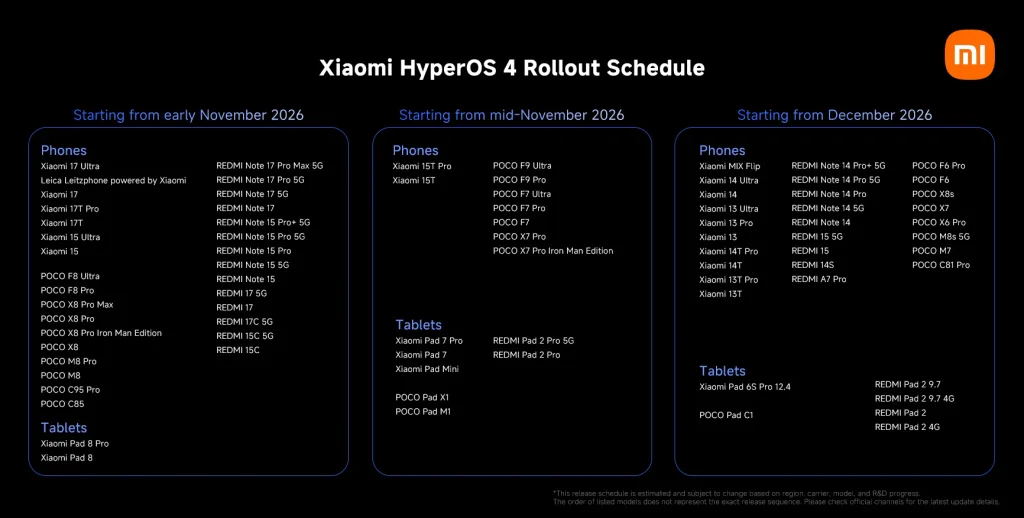
Xiaomi has started the global rollout of stable HyperOS 4, its Android 17-based operating system, publishing a schedule on 3 November 2026 that covers 82 Xiaomi, Redmi and POCO devices through December. The first global build has already appeared for the POCO F8 Pro as OS4.0.2.0.XPKMIXM.
The schedule Xiaomi shared lists 67 phones and 15 tablets across three waves. Thirty-three devices are due from early November, including the Xiaomi 17 Ultra, Xiaomi 15, Redmi Note 17 and Redmi Note 15 lines, and POCO F8 Ultra. Sixteen follow from mid-November, including the Xiaomi 15T and POCO F7 series, and the final 33 start in December, including the Xiaomi 14 and 13 series and the Redmi Note 14 family.
Xiaomi describes the timeline as “estimated and subject to change based on region, carrier, model, and R&D progress,” and says the order of the listed models does not reflect the exact release sequence. It has not given dates for individual devices, and till yet it has not outlined any rollout plans for 2027.
The first wave starts with the seven phones Xiaomi admitted to its global beta program in September: the Xiaomi 17 Ultra, Leica Leitzphone powered by Xiaomi, Xiaomi 17, Xiaomi 17T Pro, Xiaomi 17T, Xiaomi 15 Ultra and Xiaomi 15. It also includes budget models, which puts the Redmi 15C and POCO C85 ahead of the Xiaomi 14 Ultra and Xiaomi 13 Ultra, neither of which starts until December.
The global schedule follows the stable release in China, which began on 15 October 2026. Xiaomi started HyperOS 4 beta testing there in August.
Table of Contents
HyperOS 4 introduces Soft Light Glass, a design built on translucent layers and lighting effects, along with resizable home screen folders, stacked lock screen notifications and a lock screen clock that can be rescaled and repositioned. Not every listed device will get the full look: Xiaomi reserves the complete effects for Snapdragon 8 Elite-class, Dimensity 9500-class and supported XRING chips.
Xiaomi’s performance figures come from its own testing. With the global beta, the company claimed 33% more available memory after eight hours of continuous use, 14.7% fewer total instructions and a 90% cut in the time needed to scan 10,000 photos, compared with HyperOS 3. Its China materials gave a lower memory figure of 27.2%.
Some AI features may not make the trip. XimiTime co-founder Emir Bardakçı wrote that certain capabilities depend on China’s Super XiaoAi infrastructure, which leaves their availability in the global version uncertain.
No Redmi Note 13 model appears on the schedule. XimiTime reported that Xiaomi has canceled Android 16-based HyperOS 4 builds for the Redmi Note 13 Pro, Redmi Note 13 Pro+, Redmi Note 13 Pro 4G, Redmi K60 Pro, Redmi K70 Pro, POCO X6 5G and POCO M6 Pro 4G. Xiaomi’s schedule does not address those reports.
The Redmi Note 14 5G is listed for December, although it was one of two phones not expected to qualify in HyperOS Update’s May device list, which was compiled from update policy and leaks before Xiaomi published anything official. The other phone, the POCO M7 Pro 5G, is not on the schedule.
Owners of listed devices can check by opening Settings, going to About phone, and tapping the HyperOS version. The POCO F8 Pro package is about 8.4 GB, so it is worth backing up the phone and clearing storage before downloading, particularly if a full package is offered.
Official builds appear on the HyperOS 4 update list by device and region. Anyone installing a Recovery ROM manually should match both the exact model and the region, since the same phone can have separate Global, EEA, and India builds.
The schedule does not name India or any other market. It is estimated that India will receive HyperOS 4 in November or December as part of the global rollout, but that is the tracker’s estimate rather than a Xiaomi date. The schedule also does not say which models will run Android 17 and which, if any, will get HyperOS 4 on Android 16, a build type MIUIROM says also exists.
Instant Telegram alerts with download links.
Xiaomi’s HyperOS 4 beta starts August 14 across 26 devices in three waves. Full device list, dates, and the soft-light…

HyperOS 4 drops MIUI's legacy code entirely, adds Leica UI theming, and covers 70+ devices — but two popular phones…

Xiaomi's latest HyperOS 3 bug fix report patches Game Turbo resets, SMS glitches, and browser crashes — POCO users are…